
The Opportunity Radar
Peru has a lot of support on offer for small businesses: free formalization and management advice at PRODUCE's Tu Empresa centers, tax regimes designed for small taxpayers, guaranteed credit through COFIDE, export training at PROMPERÚ, technical services from the CITE network, trade fairs, contests, and platforms for women entrepreneurs. The hard part is finding the ones that fit. They are spread across dozens of agencies and websites, each with its own criteria (what kind of RUC you have, a sales ceiling or floor, which region you operate in, how long you have been operating, whether you belong to an association, whether the business is led by a woman), and many of them open for a few weeks and close again, with the opening often announced only on the agency's Facebook page. Some programs that still turn up in search results stopped taking new applicants years ago. An owner running a bodega twelve hours a day is not going to work through all of that, and the ones who try often find out at the end that a legal-entity or sales requirement rules them out. In our conversations we see owners ask for "apoyo del estado" in exactly those general terms, with no idea where to start.
What the Radar does
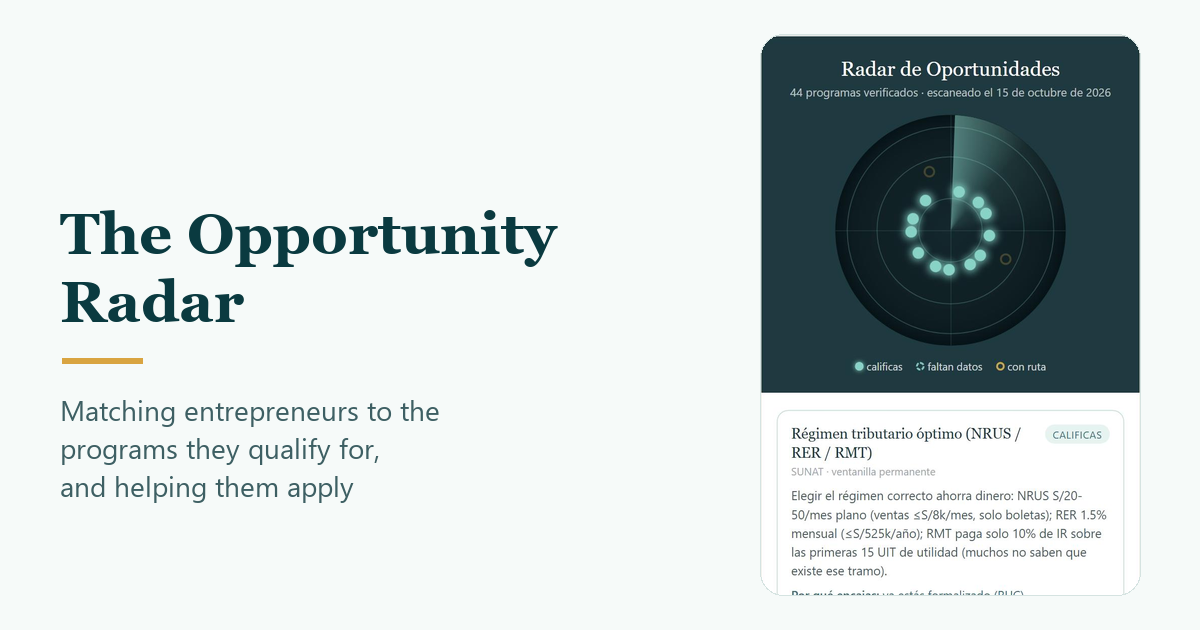
Since July, MAIA users in Peru can get an Opportunity Radar: a private web page, linked from their WhatsApp chat, that checks a registry of current programs against what MAIA already knows about their business. The registry currently holds 47 programs, each with its eligibility criteria written as explicit rules and verified against the program's own primary source, and we refresh it on a regular cycle to catch windows opening and closing. A few entries are there specifically so that MAIA does not recommend them, because they are dormant or closed to new applicants. The matching itself is plain code, not a language model guessing about eligibility.
Most of the first cut comes from the profile MAIA has already built in conversation, since sector and niche are known for nearly every user. When criteria are not known (RUC type, sales band, region, years operating, association membership, women-led), they become a few one-tap questions on the page, and the page only asks the ones that would change the result. The owner then sees confirmed matches, likely matches that need one more answer, and the programs they do not qualify for, with the reason.
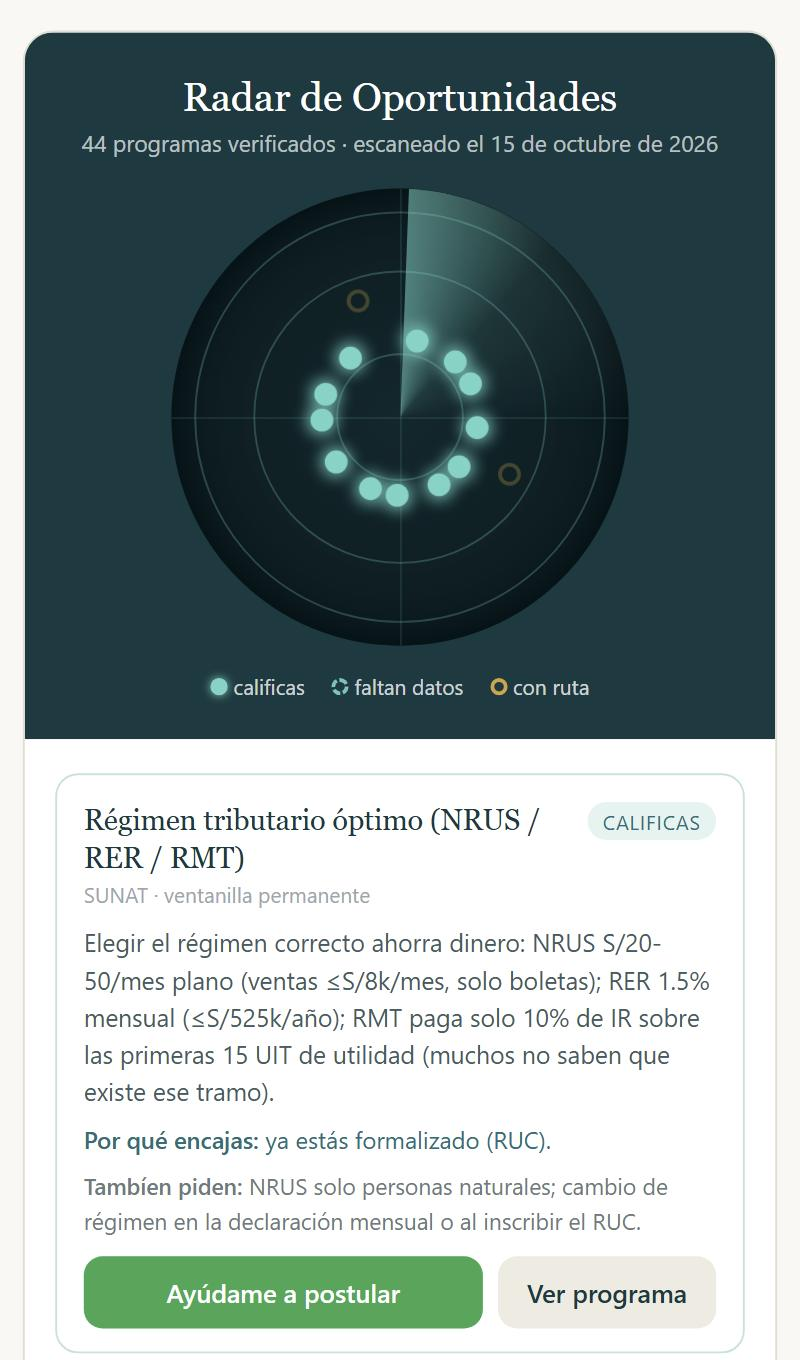
An illustrative Radar page, generated for a made-up poultry business in San Martín.
Each match has a button that says "MAIA, ayúdame a postular" (help me apply). It takes the owner back to WhatsApp, where MAIA picks up with the program and the owner's details already in context and works through it with them: what the program actually requires, which documents to bring, where to go, and a draft of the request. MAIA has web search on, so it checks current addresses, requirements and dates before passing them on.
The context it builds
A key outcome is how much the Radar teaches MAIA about the business. The answers from the page flow back into the conversation as statements from the owner, and from there into the profile that drives all future coaching. Through early October, 78 owners answered 296 Radar questions, in about a minute each. Knowing whether someone is in the Nuevo RUS or the RMT, what band their sales are in, and where they operate changes what good advice looks like for them, from tax tips to the size of a realistic sales target to which regional fair is worth the trip.
An egg producer in San Martín
In late August a new user wrote to MAIA asking for "asesoría para los mype". He picked "other business", said poultry, and in his third message wrote that he wanted to access state support for small businesses. MAIA sent him his Radar link. Within seven minutes he had answered five questions on the page (among them: RUC as a natural person, not in an association, sales under S/2,000 a month, operating in San Martín), and the Radar showed him ten confirmed matches. He tapped "help me apply" on three of them: formalization advice at Tu Empresa, a check of his tax regime, and the Amazon law (Ley 27037), which offers tax benefits to businesses in San Martín.
Over the next half hour MAIA put together a basic business sheet with him (production and sale of eggs, 200 hens, about S/1,400 a month, sold to bodegas), pointed out the official spelling of his district before he used it on any form, and gave him the nearest Tu Empresa center in Tarapoto with its address, opening hours and WhatsApp number, plus a message ready to send.
We do not know yet whether he has contacted the center, and he has not told us. What we do know is that after about forty minutes on his first night, MAIA knew his flock size, his monthly sales, his customers, his tax regime and his location, and his coaching has run on that ever since. His October plan was to get a folder of his documents ready for state support, and last week MAIA opened a conversation about how much it really costs him to produce each egg, starting from the S/1,400 he had mentioned in August. He replied "sí, me pasa" (yes, that happens to me), and they are working through his feed costs now.
The bottom line
Owners do not lack interest in public support, they lack a way to find what they qualify for, and checking explicit criteria against a profile we already have is a cheap way to give them that. Helping someone apply means walking through requirements and documents with them, and sometimes telling them to stay where they are. Every Radar scan fills in facts that months of conversation had not, and that makes the rest of MAIA's coaching better.